
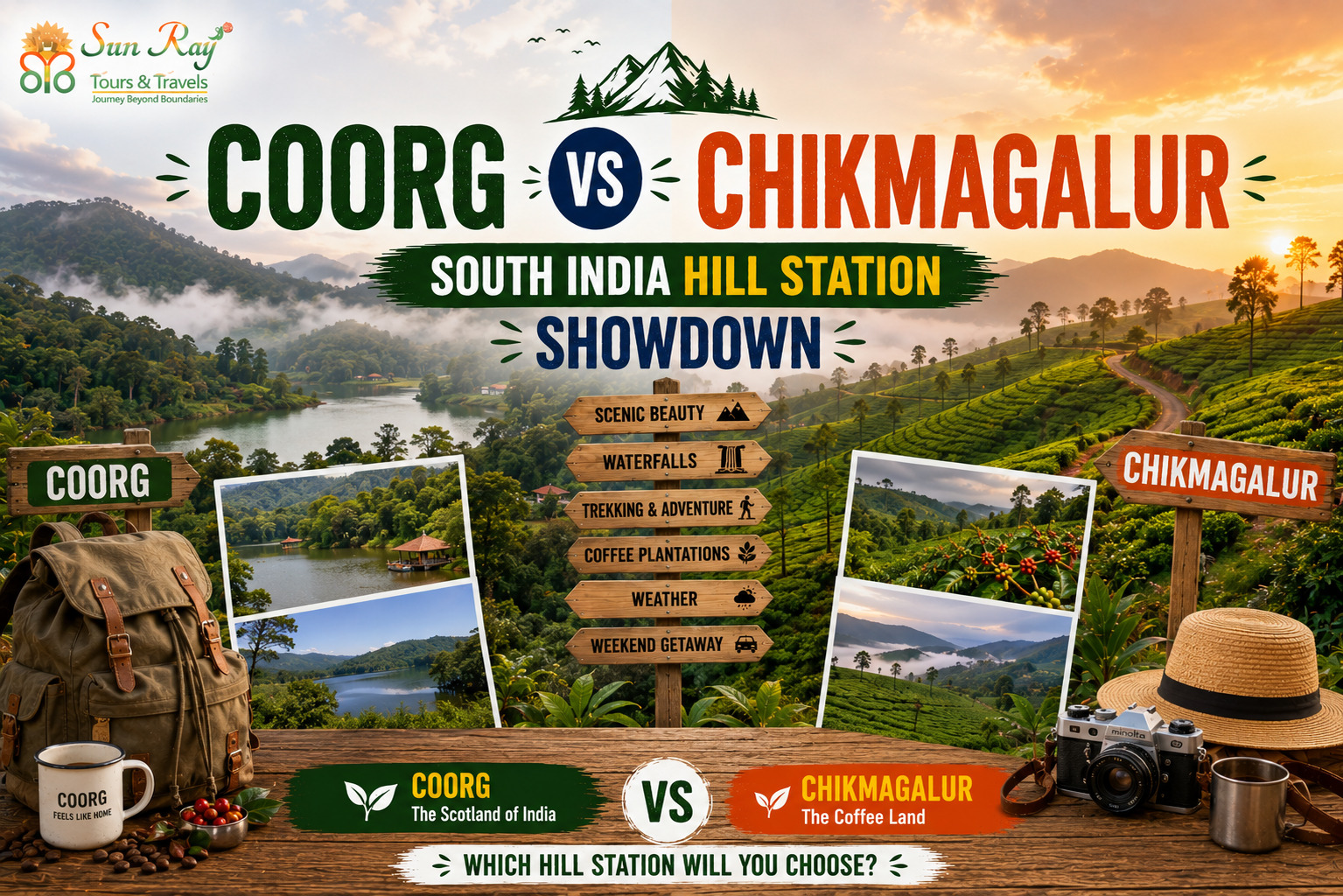
Coorg vs Chikmagalur: South India Hill Station Showdown
You are standing at a fork in the road, literally. One path takes you deeper into mist-draped coffee forests and a culture unlike anywhere else in India. The other leads to Karnataka’s highest peak, where the sunrise turns the entire Western Ghats gold. Both paths are beautiful. Both will leave you wanting to come back. But you can only pick one this weekend.
That is the Coorg vs Chikmagalur dilemma. And it is a genuinely tough call.
Both hill stations sit in Karnataka, are wrapped in coffee plantations and cool air, and are within a day’s drive of Bengaluru. Yet they feel completely different once you arrive. Coorg carries the weight of a deep, indigenous culture; the Kodava people have lived and farmed here for centuries. Chikmagalur, on the other hand, is raw nature at its finest, built around ridgelines, forest trails, and one of India’s most extraordinary trekking peaks.
This guide covers everything: geography, weather, places to visit, trekking, food, accommodation, budget, best time, and a clear verdict for every type of traveler. By the time you finish reading, you will know exactly which one is right for you.
Quick Comparison: Coorg vs Chikmagalur at a Glance
Understanding the Two Destinations
What Is Coorg?
Coorg, officially known as Kodagu, is a district in the southwestern corner of Karnataka, bordering Kerala. It sits in the heart of the Western Ghats and is often called the “Scotland of India” for its rolling green hills, misty mornings, and cool, damp weather. The region is home to the Kodava community, a warrior people with their own language, cuisine, traditions, and martial arts. This cultural depth sets Coorg apart from almost every other hill station in South India.
The main town is Madikeri, which serves as a practical base. From here, travellers can reach waterfalls, viewpoints, elephant camps, temples, and coffee estates within short drives. Coorg is also known for its spice gardens, cardamom, pepper, and ginger grow alongside coffee across the district.
What Is Chikmagalur?
Chikmagalur is a small hill town in central Karnataka, also tucked into the Western Ghats. It holds a proud title: the birthplace of Indian coffee cultivation. Legend holds that a Sufi saint named Baba Budan brought coffee beans back from Yemen in the 17th century and planted them on the Baba Budangiri hills, which lie just outside Chikmagalur town.
Where Coorg has culture and variety, Chikmagalur has altitude and altitude alone. Mullayanagiri, at 1,930 metres, is the highest peak in Karnataka. The landscape around Chikmagalur is more open, more dramatically hilly, and far less commercially developed. It attracts trekkers, photographers, and anyone who wants real quiet.
Location and How to Reach
Getting to Coorg
Coorg does not have its own airport or railway station. The nearest airport is Mangalore International Airport, about 150 km from Madikeri. Most travelers drive from Bengaluru; the NH275 via Mysuru offers well-maintained roads. The journey from Bengaluru takes around 5 to 6 hours by car. Buses from Mysuru, Mangalore, and Bengaluru also run regularly.
Pro tip: If you are coming from Bengaluru, the Bengaluru- The Mysuru expressway has cut down drive time considerably. Many people stop for a meal in Mysuru before heading into the ghats.
Getting to Chikmagalur
Chikmagalur is slightly closer to Bengaluru, at around 245 km. The drive takes about 4 to 5 hours via NH 75 (Bengaluru-Mangalore highway). Hassan, about 50 km before Chikmagalur, is a natural pit stop. The nearest airport is Mangalore Airport, roughly 160 km away.
Verdict on accessibility: Chikmagalur edges ahead in ease of road access from Bengaluru, and the NH75 is generally in excellent condition. Coorg is slightly harder to reach on the final stretch due to ghat roads.
Coorg vs Chikmagalur: Weather and Best Time to Visit
Coorg Weather
Coorg is a year-round destination, but each season has a different personality.
October to March is the most popular time. The weather is cool and dry, with temperatures between 10°C and 22°C. This is perfect for sightseeing, outdoor activities, and plantation walks.
April to May brings mild heat, pleasant by Indian standards but warmer than the winter months. Flowers bloom across the hills, and the air carries a heavier fragrance of coffee blossoms.
June to September is the monsoon season. Coorg receives very heavy rainfall, among the highest in India. The waterfalls are at full throttle, and the forests turn an almost unreal shade of green. However, leeches are common on forest trails, and some roads become difficult. This season suits travelers who love the dramatic beauty of the rain.
Chikmagalur Weather
Chikmagalur follows a similar pattern, but with one distinct difference: its higher elevations mean cooler temperatures and more dramatic mist.
September to February is the sweet spot. After the monsoon, the hills retain their green while skies are clear enough for stunning sunrise views at Mullayanagiri and other peaks. Temperatures drop to 10°C at night in winter.
The monsoon (June to September) is spectacular in Chikmagalur. The mist on the ridge roads can be so thick that visibility drops to a few meters. Waterfalls like Hebbe Falls and Sirimane Falls are at their most powerful. That said, trekking gets harder, and jeep tracks can become impassable.
Verdict on weather: Both are at their best from October to February. For the monsoon experience, Chikmagalur’s mist-covered peaks give it a slight edge in sheer visual drama.
Places to Visit in Coorg
Coorg has a well-developed tourist circuit with many places to visit within comfortable driving distance of Madikeri.
Abbey Falls
One of the most photographed spots in Coorg, Abbey Falls, sits about 10 km from Madikeri. The waterfall drops sharply through a frame of overhanging coffee and spice plantations. It is accessible year-round, though the flow is most impressive from July to October.
Raja’s Seat
A hilltop garden in the heart of Madikeri, Raja’s Seat offers sweeping views of the valleys and hills. The name translates to “King’s Throne” – the Kodava kings reportedly sat here to watch sunsets. Entry is free, and the best time to visit is early morning or late evening.
Dubare Elephant Camp
Located along the banks of the Cauvery River, Dubare Elephant Camp is one of the most cherished experiences in Coorg. Visitors can watch forest elephants being bathed and fed by their mahouts and even participate in feeding sessions. The camp operates in the morning and evening, with morning slots generally offering a better experience.
Namdroling Monastery (Golden Temple), Bylakuppe
About 35 km from Madikeri lies the largest Tibetan settlement outside Tibet. The Namdroling Monastery, also called the Golden Temple, is extraordinary. Its enormous golden Buddha statues, intricate murals, and the quiet hum of prayer create an atmosphere unlike anything else in South India. It is free to visit, and the experience is calming and culturally rich.
Talacauvery
The source of the river Cauvery, Talacauvery sits at 1,276 metres in the Brahmagiri Hills. A short climb from the temple complex rewards visitors with panoramic views over Karnataka and Kerala. This is a sacred site for Hindus, and the atmosphere is serene.
Iruppu Falls
Also known as Lakshmana Tirtha Falls, Iruppu is a sacred waterfall near the Kerala border. Set inside dense forest, the falls crash down a rocky face framed by tall trees. The trek to reach the falls is short and manageable for most visitors.
Madikeri Fort
Built in the 17th century and expanded by Tipu Sultan, Madikeri Fort stands in the centre of the town. The fort now houses a museum, government offices, and a small church built by the British. It provides a quick but interesting glimpse into the layered history of Coorg.
Harangi Dam and Reservoir
About 30 km from Madikeri, the Harangi reservoir is a quiet spot for boat rides and picnics. The surrounding landscape of green hills reflected in still water makes for lovely photography.
Places to Visit in Chikmagalur
Chikmagalur’s attractions lean heavily towards natural landscapes, peaks, trails, waterfalls, and coffee estates.
Mullayanagiri
Karnataka’s highest peak, standing at 1,930 metres. The trek to the summit is beginner-friendly and can be completed in about two hours round-trip. The trail passes through grasslands, shola forests, and exposed ridgelines. The sunrise view from the top, with clouds rolling below and the Western Ghats spread out on all sides, is extraordinary. For anyone doing a Coorg vs Chikmagalur comparison, Mullayanagiri is a trump card for Chikmagalur.
Baba Budangiri Hills
A sacred site shared by both Hindu and Muslim communities, Baba Budangiri holds the cave shrine of Datta Peeta and the tomb of Sufi saint Baba Budan. The hills sit at around 1,895 metres and the drive up offers views of coffee and cardamom estates. Manikyadhara Falls, which translates to “Stream of Pearls,” flows near the shrine.
Kemmangundi
A hill station within a hill station, Kemmangundi is a quiet, cool retreat at 1,434 metres. Originally developed as a summer retreat by Krishnaraja Wadiyar IV of the Mysore royal family, it is now a garden town with rose gardens, viewpoints, and easy walks. Hebbe Falls and Z Point are nearby highlights.
Hebbe Falls
About 8 km from Kemmangundi, Hebbe Falls drops in two tiers through thick forest. Reaching it requires either a jeep ride on rough forest tracks or a 4 km trek. The effort is worth it, few waterfalls in South India have this kind of remote, undisturbed feeling.
Sirimane Falls
Located around 30 km from Chikmagalur town, Sirimane Falls is a wide, two-tiered waterfall set against a backdrop of dense greenery. It is far more accessible than Hebbe Falls and suitable for families. The best time to visit is July to October.
Bhadra Wildlife Sanctuary
The Bhadra reservoir and its surrounding forests form a major wildlife sanctuary covering over 490 sq km. Jeep safaris give visitors a chance to spot elephants, leopards, gaur, and a wide variety of birds. The Bhadra Tiger Reserve status adds a layer of conservation significance to the area.
Z Point
Located near Kemmangundi, Z Point is a dramatic cliff viewpoint where you can see the entire valley fall away below. The name comes from the Z-shaped path on the cliff face. On clear days, views extend for dozens of kilometers over the Western Ghats.
Coffee Estates and Plantation Stays
Chikmagalur is where Indian coffee began. Several estates, particularly around the Balehonnur and Mudigere regions, offer guided plantation tours where you can learn about coffee cultivation from seed to cup. Many estate homestays include this experience as part of your stay.
Coorg vs Chikmagalur for Trekking
Trekking in Coorg
Coorg has good trekking, but it is not the primary reason most people visit. The best treks include:
Tadiyandamol: Coorg’s highest peak at 1,748 meters. The trail starts from Kakkabe village and passes through grasslands and shola forest. The 7 km trail (one way) takes about 3 to 4 hours to complete. Sunrise from the summit on a clear morning is a strong reward.
Brahmagiri: A moderate 6 km trek through dense forest near Talacauvery. The peak offers views into both Karnataka and Kerala.
Pushpagiri Wildlife Sanctuary: For serious trekkers, Pushpagiri offers routes through biodiversity-rich forests. Permits are required, and the trek is best done with a guide.
Trekking in Chikmagalur
Trekking is the core identity of Chikmagalur. The options are excellent and range from easy half-day walks to full-day ridge treks.
Mullayanagiri Trek: Easy to moderate, 2 km from the base, big views. Best for beginners.
Baba Budangiri Trek: A longer route from Seethanadi, passing through cardamom forests. Takes about 4 to 5 hours.
Kudremukh Trek: About 95 km from Chikmagalur town, the Kudremukh trek is one of the finest in South India. The peak resembles a horse’s face (Kudre = horse, Mukh = face). The 25 km return trail passes through shola forests and grasslands teeming with wildlife. This is inside a protected park and requires permits.
Devaramane Betta: A lesser-known ridge walk that offers solitude and excellent views with far fewer visitors.
Verdict on trekking: Chikmagalur wins decisively. Mullayanagiri alone justifies the trip for any trekker, and the depth of options from beginner to advanced is unmatched in Coorg.
Food: Coorg vs Chikmagalur
Coorg Cuisine
Coorg has one of the most distinctive regional cuisines in all of India, shaped by the Kodava community’s warrior traditions and forest-foraging heritage.
Pandi curry: Coorg’s signature pork dish, slow-cooked with kachampuli (a sour fruit-based vinegar unique to the region) and spices. It is rich, tangy, and deeply savory. You cannot claim to know Coorg until you have had pandi curry.
Akki roti: Thick rice flour flatbread, best eaten with fresh coconut chutney or a fiery green curry.
Noolputtu: String hoppers made from rice flour, a dish shared in Kerala. Soft, light, and perfect with coconut milk and a side of curry.
Kadambuttu: Steamed rice balls eaten with chicken or mutton curry, simple, filling, and comforting.
Coffee: Coorg produces some of India’s finest Arabica and Robusta beans. Every home and estate will serve you filter coffee that is aromatic and perfectly balanced.
Chikmagalur Cuisine
Chikmagalur’s food scene is simpler and more centered on local staples, though the coffee is arguably the best in the country.
Ragi mudde: Finger millet balls eaten with sambar or meat gravies, a staple of the Malnad region.
Nati koli saaru: A thin, spiced country chicken soup that is warming and deeply flavoured.
Plantation coffee: Chikmagalur’s connection to coffee is personal. Many estate stays serve freshly roasted, freshly ground filter coffee grown on their own land. The experience of drinking coffee on the farm where the beans were grown is hard to match.
Verdict on food: Coorg wins on distinctiveness and variety. The Kodava cuisine is genuinely unlike anything else in India and adds significant cultural value to a trip.
Accommodation: Coorg vs Chikmagalur
Staying in Coorg
Coorg has the widest range of accommodation options of any hill station in Karnataka. You will find everything from budget guesthouses to ultra-luxury resorts perched on hillsides.
Luxury resorts are a real draw here. Several properties offer private plunge pools, plantation-to-table dining, and spa treatments. Couples and families who want comfort alongside nature will find Coorg extremely well served.
Plantation homestays are another standout option. Staying with a Kodava family inside a working coffee estate, waking up to the smell of fresh coffee, and walking the rows of coffee plants in the morning is one of the best experiences South India offers.
Budget stays are available in and around Madikeri, making Coorg accessible across all price points, though it is generally more expensive than Chikmagalur.
Staying in Chikmagalur
Chikmagalur is stronger on raw charm and weaker on polished luxury. The emphasis is on plantation stays, homestays, and cottages tucked into coffee estates.
Estate homestays near the Balehonnur, Mudigere, and Sakleshpur areas are Chikmagalur’s accommodation highlight. These are often family-run, personal, and offer farm-fresh meals. The value for money is excellent.
Budget-conscious travelers will find Chikmagalur significantly more affordable than Coorg across accommodation, food, and activities.
Verdict on accommodation: Coorg for comfort and luxury. Chikmagalur for authenticity, value, and that feeling of staying inside a living coffee estate.
Coorg vs Chikmagalur for Couples and Honeymoon
Both destinations are popular for romantic getaways, but they offer different kinds of romance.
Coorg suits couples who want luxury with nature. The combination of private resort pools, plantation walks, spa experiences, and the cultural richness of Kodava food and traditions creates a deeply immersive honeymoon. Raja’s Seat at sunset, a candlelit dinner at a hillside resort, and a morning coffee walk through the estate are classic Coorg honeymoon moments.
Chikmagalur suits couples who share a love of the outdoors. Waking up at 4 AM to trek Mullayanagiri for sunrise, spending lazy afternoons on the verandah of a plantation cottage, or driving the ridge roads as mist rolls in, this is Chikmagalur’s romantic offer. It is quieter, less commercial, and has fewer crowds even during peak season.
Verdict for honeymoon: Coorg edges ahead for most couples due to better resort infrastructure and a wider range of experiences. However, couples who love nature and trekking may actually prefer Chikmagalur’s quieter, more personal atmosphere.
Coorg vs Chikmagalur for Families
Coorg is generally better suited for family trips. It has a broader range of activities that work across age groups, including elephant camps, waterfalls, viewpoints, monastery visits, and gentle plantation walks. The roads within tourist areas are well-maintained, accommodation is more family-friendly, and there is more variety to keep children and elderly family members equally engaged.
Chikmagalur can work beautifully for families if the primary interest is nature and there are older children or teenagers who enjoy light trekking. Bhadra Wildlife Sanctuary jeep safaris are exciting for all ages. Kemmangundi’s garden walks are gentle and accessible. The drive up the ghats, with mist and coffee plants on either side, is an experience children tend to remember.
Verdict for families: Coorg is the safer, more versatile pick for most family configurations.
Budget Comparison: Coorg vs Chikmagalur
Verdict on budget: Chikmagalur is the more affordable option across most categories. A couple spending two nights in Chikmagalur at a well-rated estate homestay with meals can easily come in 30 to 40% cheaper than the equivalent in Coorg.
Coorg and Chikmagalur: Can You Do Both?
Yes, and many travelers do. The two hill stations are about 120 to 150 km apart by road, taking roughly 3 to 4 hours to drive between them via Hassan. A combined 5-night itinerary that spends 3 nights in Coorg and 2 nights in Chikmagalur (or vice versa) is very manageable and extremely rewarding.
If you are considering this route, plan to break the drive in Hassan, which is worth a half-day visit for its Hoysala temples at Belur and Halebidu, two of the finest examples of medieval temple architecture in India.
Coorg vs Chikmagalur: The Verdict
There is no universally correct answer. The right destination depends entirely on what you are looking for from a trip.
Choose Coorg if:
- You are visiting a Karnataka hill station for the first time
- You are travelling with family or elderly members
- You want a combination of culture, wildlife, waterfalls, and luxury
- You are on a honeymoon and want resort-level comfort
- You want to engage with a genuinely unique indigenous culture
Choose Chikmagalur if:
- Trekking and mountain views are your priority
- You want a quieter, less commercial experience
- You are travelling on a tighter budget
- You want to experience the birthplace of Indian coffee on a farm
- You love misty, moody landscapes and long drives through mountain roads
If you can only go to one: First-time visitors to South India’s hills, and those travelling with families, will almost always leave Coorg more satisfied. Repeat visitors, solo trekkers, and nature purists often find Chikmagalur the more memorable experience.
Frequently Asked Questions: Coorg vs Chikmagalur
Which is better, Coorg or Chikmagalur?
Both are excellent hill stations in Karnataka with different strengths. Coorg is better for cultural experiences, families, and luxury stays. Chikmagalur is better for trekking, peace, and budget travel. The best one depends on your travel style.
Which is closer to Bengaluru: Coorg or Chikmagalur?
Chikmagalur is slightly closer at about 245 km, compared to Coorg at about 265 km. The drive to Chikmagalur via NH75 is also generally faster, at around 4 to 5 hours.
Can I combine Coorg and Chikmagalur in one trip?
Yes. The two destinations are about 120 to 150 km apart. A combined 5-night trip covering both is very popular and highly recommended. Many travelers route their trip from Bengaluru to Chikmagalur, then to Coorg, then back to Bengaluru or Mysuru.
Which is better for trekking, Coorg or Chikmagalur?
Chikmagalur is clearly better for trekking, with Mullayanagiri (Karnataka’s highest peak) and Kudremukh being standout options. Coorg has good treks, but they are not its primary attraction.
Which is better for a honeymoon, Coorg or Chikmagalur?
Coorg edges ahead for most honeymooners due to its luxury resort options and broader range of experiences. However, couples who love trekking and nature may prefer Chikmagalur’s quieter, more authentic setting.
What is the best time to visit Coorg vs Chikmagalur?
October to March is the best time for both. Coorg is also pleasant through April and May. For monsoon travel, both become dramatically beautiful but require preparation for rain and leeches.
Which is cheaper, Coorg or Chikmagalur?
Chikmagalur is generally more affordable across accommodation, food, and activities. Budget-friendly travelers will find better value there.

Recent Posts

Best Hill Stations in India for Summer: Top 15 Picks

Best Cities to Visit in India – Ultimate Bucket List

Best Beach Resorts in Andaman for Honeymoon: Your Complete Romantic Getaway Guide
Tags

Thailand
